
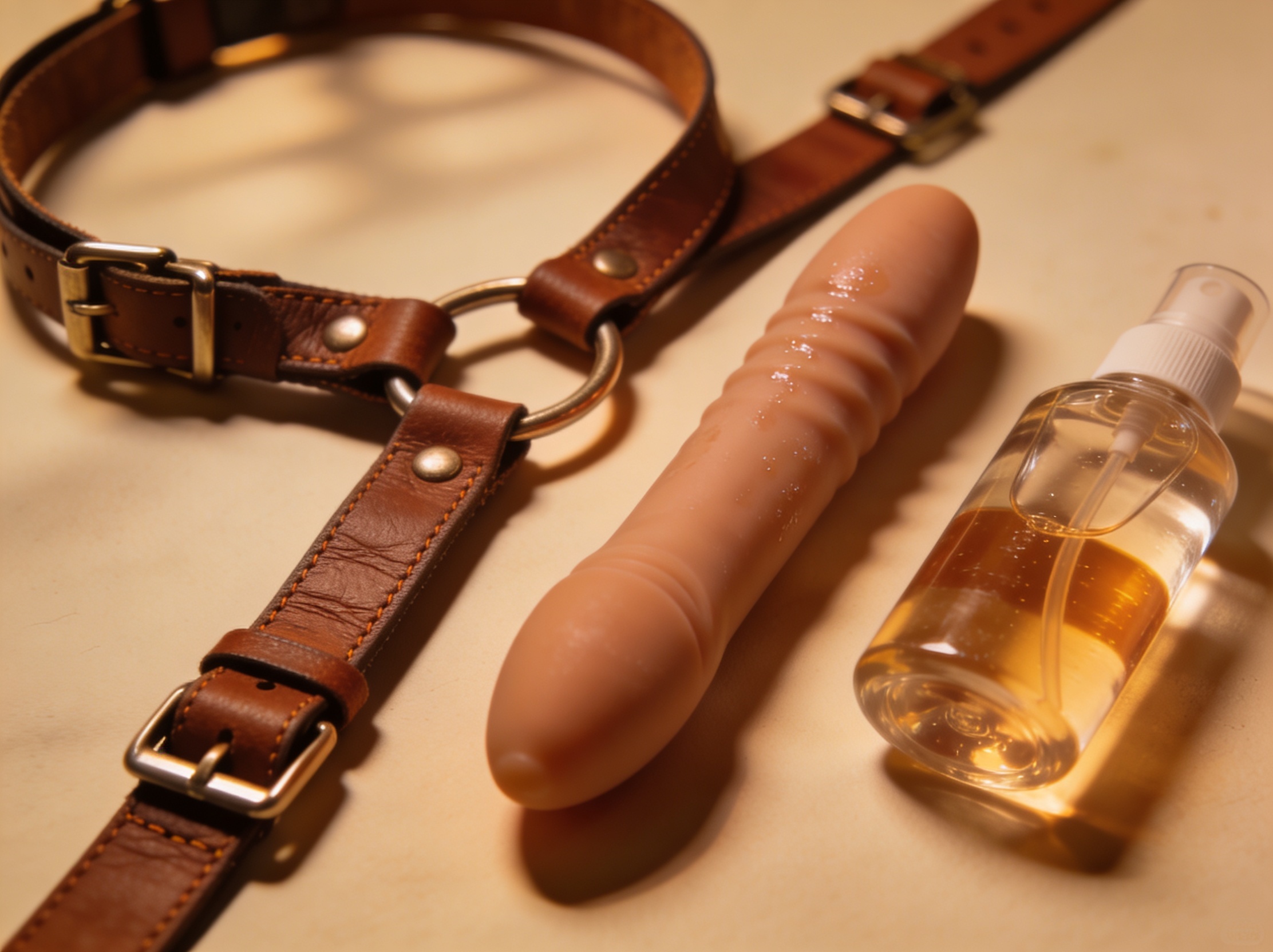
The strap-on is one of the most quietly versatile objects in the whole world of sex toys, and also one of the most caricatured. Pop culture treats it as a single punchline; in real life, it’s a piece of equipment that solves quite different problems for queer women, gay men, mixed-gender couples curious about pegging, kink-curious couples exploring power-dynamic play, and — perhaps most surprisingly — men whose erections aren’t cooperating after surgery, medication, or simply the passage of time. One object, several genuinely separate use cases. This guide takes each of them seriously.
The aim here is to keep things clear and unfussy: what a strap-on actually is, the four main shapes it comes in, how to make sure the harness fits a body that isn’t a mannequin, and the small handful of things worth knowing about materials and care. No jargon without a translation, and no assumptions about who’s reading.
What a Strap-On Actually Is
Strip the marketing away and a strap-on is just two parts: a wearable piece (the harness) and a removable insertable piece (usually a dildo). The wearer puts on the harness; the dildo locks into a ring on the front. The whole point of the design is that one harness can hold many different dildos — in different sizes, shapes, colours, and materials — so couples can keep the same setup and change one variable at a time. The dildo never enters the wearer’s body; it sits flush against the front of the harness, which is what makes the contraption practical for anyone, regardless of anatomy.
That’s the universal version. There are also two important variants. A strapless strap-on has no harness at all — one bulb sits inside the wearer, held in place by their pelvic muscles, while a longer external shaft does the penetrating. And a hollow strap-on is a shell rather than a solid dildo, designed to slip over an existing penis (with or without an erection), effectively extending or substituting for it. We’ll come back to that one — it’s the piece most guides skip entirely.
The Four Harness Types, Without the Marketing Speak
Most strap-on confusion starts here. Harnesses look superficially similar in photos, but the way they sit on a body — and the way they distribute pressure during use — is genuinely different. Four broad categories cover almost everything on the market.
Jockstrap and brief harnesses
These are the closest thing to a default. A waistband with two leg straps that frame the front opening, like a jockstrap; or a fuller “panty” / “brief” cut that wraps the hips. They’re stable, comfortable for most body shapes, and the easiest type for first-timers — there’s less to fuss with mid-session. Most all-in-one beginner kits use this style. The trade-off is that the rigid front plate sits flat against the wearer, which means the wearer’s own genitals don’t get much direct stimulation from the harness itself (a vibrator pressed between body and harness is the usual fix).
Thigh harnesses
These wrap around a single thigh rather than the hips. The dildo sticks out at right angles, which sounds odd until you realise this is the harness for couples where one partner has a hip injury, mobility limitation, or simply prefers a different angle. It’s also useful for solo use. Less common, but a quietly excellent option that doesn’t get talked about enough.
Strapless (“double-ended”) harnesses
Not really a harness at all. The toy has a bulb on one end that sits inside the wearer’s vagina, anchored by their pelvic floor; the other end protrudes for penetrating a partner. The appeal is intimacy — both partners feel something, and there’s no fabric or buckle between them. The trade-off is that holding the bulb in place takes pelvic-floor muscle, especially during energetic use, and many wearers find that adding an O-ring harness over the top (yes, both at once) gives them the connection of a strapless with the security of a traditional strap-on.
Hollow / support harnesses
This is the variant that quietly solves a real problem most product pages don’t even name. Instead of a solid dildo, the insertable piece is hollow — a sleeve that slides over an existing penis. The wearer can use it whether they have an erection or not, which makes it directly relevant to men recovering from prostate surgery, men managing erectile dysfunction from medication or age, or simply anyone whose erection isn’t reliable on a given evening.
This use case isn’t niche. Prostate Cancer UK has reported that around 76% of men treated for prostate cancer experience erectile dysfunction afterwards, and Cancer Research UK notes that radical prostatectomy frequently affects the nerves involved in erection, which is why the issue is so common. A hollow strap-on doesn’t fix any of that — but it does mean partnered penetration stays on the menu for couples who’d otherwise feel it had quietly closed.
ERECTION ASSISTANT Hollow Strap-On — 24 × 4.5 cm
A hollow design with a rigid inner core, an adjustable elastic harness, and a high back strap for comfort. Designed to be wearable with or without an erection — the option many guides leave out.
Choosing a Harness That Actually Fits Your Body
Most strap-on advice assumes a single standard body, which is exactly why so many first-time buyers end up frustrated. A few things genuinely matter.
Adjustable straps beat fixed sizes. Look for buckles or sliders rather than fixed elastic loops. Bodies change weight, fluctuate across cycles, and aren’t symmetrical; an adjustable harness handles all of that without complaint. If you’re between sizes or shopping for two people to share, adjustable is the right answer almost every time.
Where the straps land matters more than waist size. Some harnesses sit high on the hipbones, others lower on the upper thigh; the same waist measurement can feel snug on one design and loose on another. If a harness will be passed between partners, this is the thing to test together rather than buy on a single measurement.
O-ring diameter is the fitment number to actually check. The O-ring is the hole at the front of the harness that the dildo’s base passes through. Most standard harnesses use a 3.8 cm (1.5 inch) ring, which fits most beginner and mid-size dildos, but bigger toys need wider rings. Many harnesses ship with two or three interchangeable rings — a small detail that quietly future-proofs the whole purchase.
NATHY Adjustable Strap-On Set — 19 × 4 cm
A solid first-time choice: adjustable belt that handles a range of body sizes, plus a removable realistic dildo so you can swap in different toys later without buying a new harness.
Matching a Dildo to a Harness
The big mistake here is buying a harness and a dildo that don’t physically fit each other. Three things to check before you commit.
The dildo needs a flared base. A flared base is the disc-shaped flange at the bottom that’s wider than the shaft. It does two jobs: it stops the toy slipping all the way through the harness ring, and (separately) it stops it disappearing inside someone if you ever use it for anal play. Toys without a clearly flared base aren’t suitable for harness use. If a product page doesn’t show the base in the photos, that’s worth asking about before buying.
Match base diameter to ring diameter. The base needs to be slightly larger than the O-ring (so it can’t pull through) but not so much larger that it won’t pass through at all. Manufacturers’ product specs usually list both numbers. If you’re choosing a toy from a different brand than your harness, take thirty seconds to check.
Weight is the variable nobody mentions. Long, heavy dildos pull a harness downward over time and can feel surprisingly tiring for the wearer. For a first toy, something in the 15–20 cm range is much more comfortable than the 25 cm options that look impressive in photos. There’s a reason almost every “beginner kit” comes with something in the smaller bracket.
If you’d rather skip the matching exercise entirely, a strapless toy bypasses it — one product, one purchase, no compatibility maths.
Strapless Strap-On with Anal Stimulator — 19.5 × 3.8 cm
A strapless option that adds an anal stimulator for the wearer, so both partners feel something. Phthalate-free TPE, IPX-8 waterproof for easy cleaning.
What “Body-Safe” Actually Means
Sex toys aren’t regulated as strictly as medical devices anywhere in the world, which means the burden of checking what a product is made of falls on the buyer. The shorthand “body-safe” usually points to two properties: a material that’s non-porous (so it can be cleaned without trapping bacteria in microscopic surface pits), and one that doesn’t contain phthalates — a class of plasticisers used to make PVC flexible.
Phthalates aren’t a fringe concern. The European Chemicals Agency lists several phthalates as substances of very high concern under REACH and notes their endocrine-disrupting properties, which is why “phthalate-free” is now a near-universal selling point on European product pages. In practice this means: medical-grade silicone is the gold standard, modern formulations of TPE and TPR are usually fine if labelled phthalate-free, and any toy described simply as “jelly” or “rubber” with no further detail is best avoided. A toy you intend to share between partners is one place where it’s especially worth paying for a known material — bacteria and porosity matter more when more than one body is involved.
Lube, Briefly
Two things to know. First: silicone toys and silicone lubricants don’t get along. The lube can degrade the surface of the toy over time, leaving it tacky and harder to clean. Water-based lube is the safer default for almost everything, and it’s what most manufacturers (including Belupa) recommend in their product care notes. Second: harness use generally needs a bit more lube than expected, because the wearer can’t feel friction the way they would with their own anatomy. Reapply early and often; nobody has ever regretted it.
Strap-Ons in Kink and Power Play
The strap-on has a quietly central place in kink culture, and it’s worth saying why. The toy creates a clean physical inversion of an assumed dynamic — who penetrates, who’s penetrated — and for a lot of couples that inversion is itself the point. D/s role-play, switch dynamics, and the gentle thrill of doing something that feels like a small transgression all map onto a strap-on more naturally than onto almost any other toy. The mechanics are the same as everything described above; what changes is the framing around them.
Aesthetic choices matter more here than in vanilla use. A plain elastic harness reads as practical; a leather-look harness with visible hardware reads as deliberate. Pairing the strap-on with even one small accessory — a feather tickler, a blindfold, a soft restraint — shifts the register noticeably without escalating intensity. Belupa’s BDSM section stocks the lighter end of this range, including ticklers, restraints, and cock rings, for couples who want to add one or two elements rather than build a whole kit. The usual rule applies: introduce one variable at a time, and check in afterwards.
The Conversation Most Guides Skip
Strap-on play involves a clearer-than-usual division of roles: who wears, who receives, and what each person actually wants out of it. The temptation is to plan all of this beforehand and then never speak about it again. The better version is shorter and ongoing: a couple of sentences about what you’re each curious about before you start, a couple more during about pace and angle, and a quick check-in afterwards about what worked. None of this needs to be solemn. “Slower, lower, yes there” is a perfectly complete piece of feedback.
One specific thing worth saying out loud: for couples introducing a strap-on into a relationship that’s previously involved one partner penetrating the other, the role-swap can feel emotionally charged in a way that catches people off-guard. That’s normal, it doesn’t mean anything has gone wrong, and it’s almost always easier to talk about briefly than to silently work around. The toy is, in the end, just a tool. The relationship around it is doing all the actual work.
Where to Browse
Belupa’s full wearable dildos and strap-ons category includes adjustable beginner sets, hollow strap-ons for the use case above, strapless options, and a range of compatible dildos in different sizes and skin tones. Filtering by “in stock” and “adjustable” is a good shortcut for a first purchase; once you know what fits, you can branch out from there.
The Short Version
A strap-on isn’t one product — it’s a small system of harness, dildo, and (sometimes) a partner who’s never used one before. Get the harness adjustable, get a dildo with a flared base, and check the O-ring measurement before pressing buy. If erection reliability is part of the picture, the hollow variant is genuinely useful and quietly under-discussed. And whichever version makes its way into your drawer, the most important piece of equipment is still the conversation around it.
Made it to the end? Here’s something to take with you.
Enjoy 10% off anything on belupa.com — discreet packaging and a free gift included with every order, as always.
STRP10
Valid on any product at belupa.com until Sunday, May 17, 2026